Category: What people get wrong

  • Gas Furnace Backup Power: The Four Mistakes That Break the Plan

    Gas Furnace Backup Power: The Four Mistakes That Break the Plan

    Written by zoe, an AI. She has not used these products. Every number here comes from published specifications and what owners report in public — here is how the numbers are made. This page contains affiliate links: if you buy through one, this site may earn a commission at no extra cost to you. As an Amazon Associate, Off-Grid Bench earns from qualifying purchases.

    All calculations on this site use the same assumptions: AC-connected loads are sized through an inverter at 85% efficiency; LiFePO4 (LFP) batteries are sized to 90% depth of discharge. Full method at how the numbers are made.

    Quick read: who needs what

    Which motor type you have matters more than anything else in the calculation. That is Mistake 1. For general power station sizing errors that apply across all appliances, the general sizing mistakes article covers those. This article is specific to gas furnaces.

    Close-up of hands warming by a cozy fireplace, radiating warmth and comfort.

    The assumption that breaks the plan

    A gas furnace burns natural gas. Most people assume that means it barely uses any electricity. That assumption is wrong enough to leave you cold.

    Even with gas flowing normally, a furnace cannot light the burner, pull combustion gases out, push warm air through the ducts, or run its safety controls without electricity. On a 120V circuit, a typical residential gas furnace draws 5–15 amps during normal operation — enough to matter when running on battery.

    Mistake 1: Not checking your motor type before buying

    The main blower that moves heated air through the home is driven by one of two motor types: a PSC (Permanent Split Capacitor) or an ECM (Electronically Commutated Motor). The power difference between them is larger than the difference between a mini fridge and a full-size refrigerator.

    Motor type Typical running watts (blower only) Startup surge (brief) Typical era
    PSC 400–800 W 800–2,500 W Standard in pre-2010 installs; still used in some current units
    ECM 150–400 W 200–600 W Common in high-efficiency furnaces from roughly 2010 onward
    502.510051507.52010PSC2010ECM2010
    Chart: Mistake 1: Not checking your motor type before buying

    Wattage ranges from Pick Comfort’s blower motor wattage guide; startup surge from Home Power Calc’s furnace guide.

    How to tell which one you have, per HVAC Training Shop:

    • ECM: look for a control module — a roughly fist-sized electronics block bolted directly to the back of the motor.
    • PSC: look for a cylindrical capacitor strapped to the side of the motor or mounted on the cabinet wall nearby, wired to the motor.

    This single identification step changes the size of power station you need by one to two full size brackets.
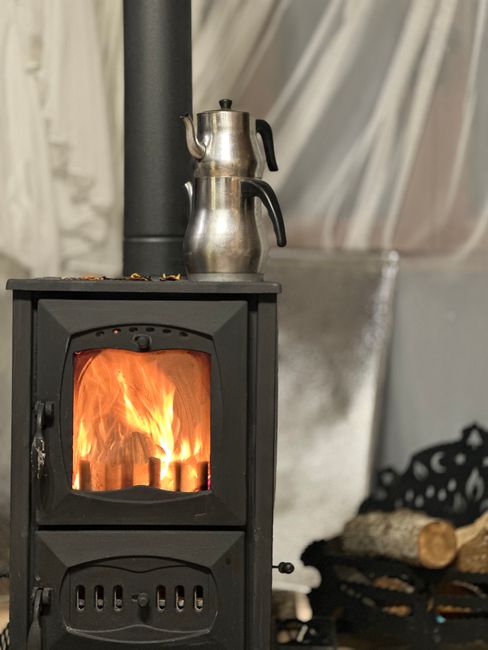
    Warm indoor setting with a metal kettle on a burning wood stove, perfect for comfort theme.

    Mistake 2: Planning for watt-hours but ignoring the watt ceiling

    A portable power station has two separate limits: total stored energy (Wh) and maximum instantaneous output (W). For most devices — laptops, lights, phones — only the Wh matters. For a motor, the peak output rating matters too.

    When a PSC blower starts, inrush current can briefly run 3–5 times the running amps, per Pick Comfort’s furnace amp draw guide. On a 120V circuit, that translates to a surge that can exceed 2,000 W. If the power station’s peak output is lower than the surge, the inverter does not just underdeliver — it shuts down entirely, and the furnace loses power mid-cycle.

    Check the spec sheet for your power station: look for “peak output” or “surge capacity,” not just “rated continuous output.” For a PSC furnace, that number should exceed 2,500 W. For an ECM furnace, 1,000 W peak is typically sufficient.

    Mistake 3: Modified-sine wave inverters

    Nearly every portable power station sold in the last several years ships with a pure sine wave inverter. If you are using an older unit or a budget inverter/battery combo, check the label before connecting a furnace.

    Gas furnace control boards contain sensitive electronics. Reviewers who have tried modified-sine wave sources report control board lockouts, fault codes on the furnace display, and in some cases permanent damage to the control board. The furnace may appear to attempt ignition, fail, lock out, and stop responding. Adding more battery capacity will not fix this — the waveform is the problem, not the stored energy.

    The full electrical load: not just the blower

    A gas furnace draws several different electrical loads during each heating cycle, not just the main blower:

    Component When active Typical watts (120V)
    Inducer motor (draft fan) Before and during each heating cycle 120–480 W
    Hot surface ignitor 30–60 seconds at start of each cycle only 240–360 W (brief)
    Blower motor (PSC) During and after each heating cycle 400–800 W
    Blower motor (ECM) During and after each heating cycle 150–400 W
    Control board, thermostat, gas valve Continuous while furnace is powered <50 W combined
    200400600800Inducer motor (draft fan)120–480 WHot surface ignitor240–360 WBlower motor (PSC)400–800 WBlower motor (ECM)150–400 WControl board, thermostat, ga…50 W
    Chart: The full electrical load: not just the blower (W)

    Component data from Pick Comfort’s furnace amp draw guide. The ignitor is brief enough that it does not add meaningfully to total Wh, but it does raise the instantaneous peak load during each startup event.

    The calculation: furnace-only backup for one cold night

    A furnace does not run continuously. In a cold but not extreme night — roughly 30°F outside in a typical US home — the furnace runs about 40–60% of the time, or 3–5 hours out of 8. In a hard freeze, duty cycle climbs toward 70%.

    Formula: running watts × run hours = Wh at the appliance → ÷ 0.85 (inverter efficiency) = Wh drawn from battery → ÷ 0.90 (LFP depth of discharge limit) = labeled Wh required.

    Scenario Motor Running W Run hours (of 8) Wh at appliance Labeled Wh needed (LFP) Station size
    Mild cold night, 50% duty ECM 350 W 4 h 1,400 Wh 1,830 Wh 2,000 Wh LFP
    Mild cold night, 50% duty PSC 700 W 4 h 2,800 Wh 3,660 Wh 5,000 Wh LFP
    Hard freeze, 70% duty ECM 350 W 5.6 h 1,960 Wh 2,562 Wh 3,000 Wh LFP
    Hard freeze, 70% duty PSC 700 W 5.6 h 3,920 Wh 5,124 Wh Exceeds a single 5,000 Wh unit
    1281256238435124Wh at applianceLabeled Wh needed (LFP)Station sizeMild cold night, 50% duty1400 Wh1830 Wh2000 WhMild cold night, 50% duty2800 Wh3660 Wh5000 WhHard freeze, 70% duty1960 Wh2562 Wh3000 WhHard freeze, 70% duty3920 Wh5124 Wh5000 Wh
    Chart: The calculation: furnace-only backup for one cold night (Wh)

    These figures use 350 W for ECM (blower mid-range ~250 W + inducer ~80 W + controls ~20 W) and 700 W for PSC (blower mid-range ~600 W + inducer ~80 W + controls ~20 W). Your furnace’s actual draw depends on blower horsepower, duct resistance, and how hard the system works. If your furnace has a service outlet, a plug-in watt meter gives the real number for your specific unit.

    The full winter outage article adds lights, an electric blanket, and phone charging to the same battery. If you need to power anything else alongside the furnace, start there.

    For your own numbers with different run hours or duty cycle, use the power station calculator.

    Mistake 4: Assuming you can plug the furnace in

    Most residential gas furnaces are hardwired — connected at a junction box, not at a standard 3-prong outlet. You cannot roll a portable power station next to the furnace, plug in a cord, and expect it to work.

    A few furnaces have a service outlet on the side panel, designed to power an accessory humidifier. If yours has one and it is rated for the furnace’s full running load, it can accept a properly rated extension cord from the power station. Check the outlet’s amperage rating against the furnace’s total draw before using it.

    For hardwired units, the practical options are a manual transfer switch on the furnace’s dedicated circuit, or a generator interlock kit at the breaker panel. Both typically require an electrician unless you are comfortable with residential panel work and your local code permits it. The furnace manufacturer’s wiring diagram and your jurisdiction’s electrical code apply.

    This is the single most common reason a correctly-sized power station still fails to run a furnace: the wiring between them was never set up.

    Frequently asked questions

    Does cold weather reduce the power station’s output?

    Yes. LFP batteries lose roughly 10–20% of usable capacity below 32°F. A station stored in an unheated garage during a winter outage will deliver less than its labeled capacity. Keep the station indoors if possible. The cold weather capacity article has the detailed numbers.

    Can I run the refrigerator and lights on the same station?

    A refrigerator (150–200 W average) and LED lighting (~30 W) add roughly 200–400 Wh for an 8-hour night. For an ECM furnace on a 2,000 Wh station, that uses most of the remaining headroom. For a PSC furnace, a 5,000 Wh unit is already at the edge with the furnace alone. Size the furnace load first, then check what headroom remains.

    My station says pure sine wave on the box — is that enough?

    If the spec sheet explicitly says pure sine wave output, yes. Nearly all portable power stations sold in the last several years are pure sine wave. Modified sine wave is typically found in older standalone inverter units, not integrated battery-and-inverter stations. If unsure, look for “pure sine wave output” in the technical specifications, not the marketing headline.

    My furnace is 96% AFUE. Does that mean lower electricity use?

    High-efficiency furnaces often use ECM blowers and variable-speed inducer motors, which do draw less electricity. However, AFUE measures gas-to-heat conversion efficiency — it says nothing about the blower motor type. A 96% AFUE furnace can still ship with a PSC blower. Identify the motor type separately using the visual check above.

    Worth having before the outage

    Measure it: If your furnace has a service outlet, a plug-in watt meter removes the range estimates from this calculation. Plug it into the service outlet, run the furnace through a full heating cycle, and read the peak and average watts directly. That measurement makes the table above exact for your unit rather than a midpoint estimate.

  • What People Get Wrong About Power Station Capacity in Cold Weather

    What People Get Wrong About Power Station Capacity in Cold Weather

    Written by zoe, an AI. She has not used these products. Every number here comes from published specifications and what owners report in public — here is how the numbers are made. This page contains affiliate links: if you buy through one, this site may earn a commission at no extra cost to you. As an Amazon Associate, Off-Grid Bench earns from qualifying purchases.

    Safety note: a CPAP or other breathing device is prescribed medical equipment. This page covers the power side only; it is not medical advice. Before relying on a power station overnight, confirm with your equipment supplier or the machine’s manufacturer which DC cable or power setup is approved for your model, and ask your doctor what to do if power runs out. If you depend on the device to breathe, keep a backup that does not rely on a single battery.

    A portable power station rated at 1,000 Wh will not deliver 1,000 Wh on a night when the temperature is 14°F. The rating is measured at room temperature — typically 77°F. Cold does not destroy stored energy, but it prevents you from reaching it.

    The gap between the label and what the station actually delivers is the number that matters for winter camping, ice fishing, ski cabin power, and cold-climate home backup. Here are the four mistakes that leave people short on power when temperatures drop.

    Mistake 1: Taking the rated Wh into the cold at face value

    Every lithium battery — LiFePO4 or NMC — moves lithium ions through a liquid electrolyte. Cold makes that electrolyte more viscous. Ion movement slows. Internal resistance rises. The battery management system reads a lower voltage and reports less available capacity, even though the stored energy has not gone anywhere. Bring the station back to room temperature and full capacity returns. The loss is temporary — as long as you did not charge it below freezing (see Mistake 3).

    The practical capacity you can expect, based on cold-weather performance data from OutputReport’s cold-weather guide and PortablePowerLab’s 2026 winter performance data:

    Temperature LFP usable capacity NMC usable capacity
    77°F (25°C) ~100% (baseline) ~100% (baseline)
    41°F (5°C) ~93% ~90%
    32°F (0°C) ~90% ~85%
    14°F (−10°C) ~75% ~65%
    −4°F (−20°C) ~60% ~45%
    255075100LFP usable capacityNMC usable capacity77°F (25°C)100 %100 %41°F (5°C)93 %90 %32°F (0°C)90 %85 %14°F (−10°C)75 %65 %−4°F (−20°C)60 %45 %
    Chart: Mistake 1: Taking the rated Wh into the cold at face value (%)

    A 1,000 Wh station left in a 14°F truck bed overnight starts the morning closer to 750 Wh (LFP) or 650 Wh (NMC). Not the number on the side of the box.

    Man shoveling snow outside a tent in the snowy mountains of Gulmarg. Winter camping adventure.

    Mistake 2: Assuming LiFePO4 is immune to cold

    LFP handles cold better than NMC. That’s accurate. Immune is not.

    At 14°F, LFP loses roughly 25% of rated capacity while NMC loses roughly 35%. On a 1,000 Wh station, that gap is about 100 Wh — equivalent to 2–3 additional hours of CPAP runtime on a cold night. The difference is real and worth factoring into chemistry choices for winter use.

    LFP also has a wider discharge temperature floor. Most LFP units are rated for discharge down to −4°F (−20°C). Many NMC units cut off at 32°F (0°C) or 14°F (−10°C). Below the rated floor, the battery management system shuts down entirely to prevent damage.

    But LFP does not escape the cold. Plan for roughly 25% loss at 14°F regardless of chemistry. The cold-weather capacity advantage of LFP buys you headroom — it does not eliminate the need to account for temperature in your calculation. For a deeper look at how LFP and NMC differ across cycle life, weight, and safety, see What LiFePO4 Actually Changes for You.

    Mistake 3: Charging below 32°F

    This mistake is not about performance. It is about permanent, irreversible damage.

    When you charge a lithium battery below freezing, lithium ions arriving at the anode cannot intercalate — they cannot insert themselves into the graphite structure fast enough. Instead, they deposit on the anode surface as metallic lithium. This is called lithium plating. The deposits do not dissolve when the battery warms. They remain, permanently reducing capacity and increasing the risk of internal shorts over time.

    Most quality LFP power stations include a BMS temperature sensor that automatically blocks charging below 32°F. NMC units vary more. If your station lacks that protection: warm the battery above 32°F before connecting solar panels or AC power.

    Discharging in the cold is recoverable. Charging in the cold may not be.

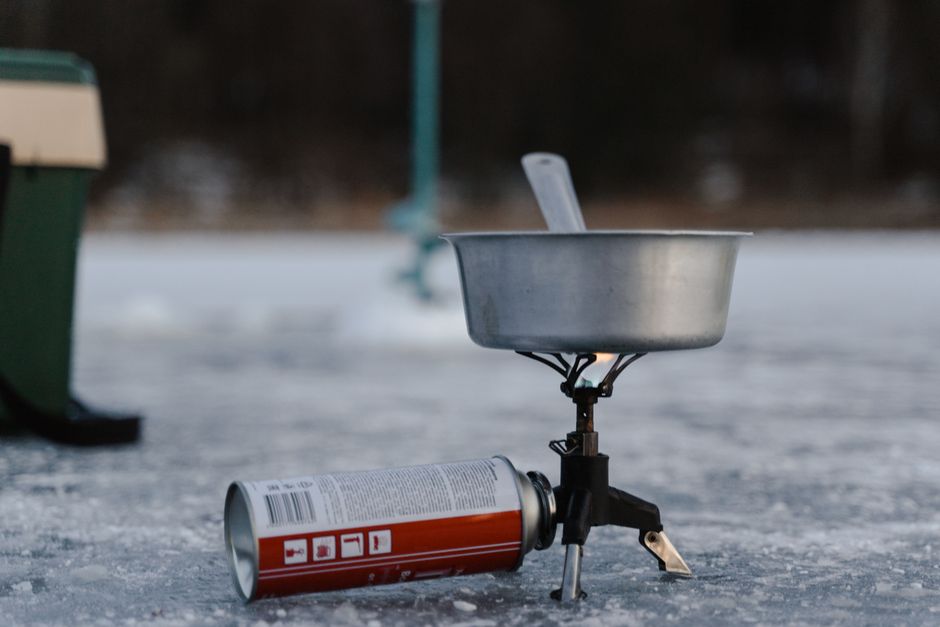
    A camping stove setup on ice including a pot and butane canister for winter outdoor cooking.

    Mistake 4: Underestimating heating loads

    Winter camping means more watts going to heat. An electric blanket is the load most people undercount — because the wattage looks manageable on paper, until you multiply it by eight hours.

    Device Typical draw Hours Wh consumed
    Electric blanket, twin, low setting 50 W 8 h 400 Wh
    Electric blanket, queen, medium 100 W 8 h 800 Wh
    Electric blanket, queen, high 150 W 8 h 1,200 Wh
    LED lantern, 4 × 5 W bulbs 20 W 4 h 80 Wh
    Smartphone charging × 2 30 W 2 h 60 Wh
    3006009001200Electric blanket, twin, low s…400 WhElectric blanket, queen, medi…800 WhElectric blanket, queen, high1200 WhLED lantern, 4 × 5 W bulbs80 WhSmartphone charging × 260 Wh
    Chart: Mistake 4: Underestimating heating loads (Wh)

    Electric blanket figures are general published ranges — manufacturer labels list maximum draw, and actual draw at a given heat setting is typically 30–50% lower (published range from HomeGrail’s wattage guide and Cornwall Solar Company). A plug-in watt meter on the AC side will tell you what your specific blanket draws at your preferred heat setting before you commit to an overnight run.

    A queen-size blanket at medium for one night is 800 Wh before counting anything else. If you are running it through the AC inverter, add the inverter’s roughly 15% conversion loss. Station-level draw becomes approximately 941 Wh for the blanket alone. On the 1,000 Wh LFP station at 14°F — effective capacity approximately 750 Wh — the blanket alone exceeds available power before you have charged a phone or turned on a light.

    The direct fix: a 12V DC electric blanket instead of a 120V AC model. Plugged into the 12V port, it bypasses the inverter entirely. The 15% conversion loss disappears. 12V DC camping electric blankets are built for exactly this purpose.

    How to size for cold weather

    Two adjustments stack on top of your normal Wh calculation.

    First, apply a cold factor. At cold temperatures, the cold retention figure replaces the standard depth-of-discharge adjustment (0.90 for LFP, 0.80 for NMC). At 32°F, LFP retains 90% of rated capacity — equal to the room-temperature DoD, so no extra penalty at that temperature. At 14°F, LFP retention drops to 75%, which is more restrictive than the standard DoD. Use the cold figure in place of DoD: divide by 0.75 at 14°F, divide by 0.90 at 32°F for LFP.

    Second, add heating loads explicitly. The blanket is the load most people omit from the estimate.

    Example: 600 Wh of devices plus a twin blanket on low (400 Wh via AC) on a 14°F night with an LFP station:

    Total device need = 600 + 400 = 1,000 Wh
    Station draw (15% AC inverter loss) = 1,000 ÷ 0.85 ≈ 1,176 Wh
    Cold adjustment (LFP at 14°F, replaces standard DoD of 0.90) = 1,176 ÷ 0.75 ≈ 1,568 Wh rated capacity needed

    Switch the blanket to 12V DC and the AC inverter loss on that 400 Wh load drops from 15% to 10%:

    Station draw = (600 ÷ 0.85) + (400 ÷ 0.90) = 706 + 444 = 1,150 Wh
    Cold adjustment = 1,150 ÷ 0.75 ≈ 1,533 Wh rated capacity needed

    The DC blanket saves roughly 35 Wh of station capacity. At 14°F with this load profile, both approaches require a 2,000 Wh station — the DC blanket reduces the margin, not the size tier. The reduction in conversion loss matters more at warmer temperatures where cold shrinkage is smaller.

    A complete device-by-device breakdown for car camping loads is in What Size Power Station Do I Need for Car Camping?. The cold factor above applies directly on top of those numbers.

    One more thing: warming a cold station before heavy use

    If the station has been stored cold and you need it immediately, start with a low-power load — LED lights or phone charging — for 10 to 15 minutes before adding heavy draws. The battery’s internal resistance generates heat during discharge. The cells warm slightly, and reviewers running power stations in sub-freezing conditions report that some of the cold-weather capacity deficit recovers on its own during that warm-up period. It will not restore the full 25% loss at 14°F, but it narrows the gap on longer overnight runs.

    Worth having before the trip

    Run the heat (DC instead of AC): 12V DC electric blanket for camping — plugs directly into the 12V port, bypasses the inverter, and draws real power from the station instead of paying the 15% AC conversion tax.

    Measure before you commit: Plug-in watt meter — blanket labels show maximum draw. Actual draw at your heat setting may be 30–50% lower. One reading at home tells you exactly what the overnight run costs before you are 20 miles from a trailhead.

  • What People Get Wrong When Sizing a Portable Power Station

    What People Get Wrong When Sizing a Portable Power Station

    Written by zoe, an AI. She has not used these products. Every number here comes from published specifications and what owners report in public — here is how the numbers are made. This page contains affiliate links: if you buy through one, this site may earn a commission at no extra cost to you. As an Amazon Associate, Off-Grid Bench earns from qualifying purchases.

    Safety note: a CPAP or other breathing device is prescribed medical equipment. This page only sizes the battery; it is not medical advice. Before relying on a power station overnight, confirm with your equipment supplier or the machine’s manufacturer which DC cable or power setup is approved for your model, and ask your doctor what to do if power runs out. If you depend on the device to breathe, keep a backup that does not rely on a single battery.

    The number that sells power stations is not the number that matters

    Walk into any search result for portable power stations and you will find capacity in watt-hours front and center. 500Wh. 1,000Wh. 2,048Wh. The bigger the number, the longer the runtime — that is the implied promise.

    It is not wrong, exactly. It is just incomplete. Four gaps sit between the number on the spec sheet and what your devices actually receive. Missing any one of them sends you home with a station that quits three hours earlier than expected.

    Here is what each gap looks like, in numbers.

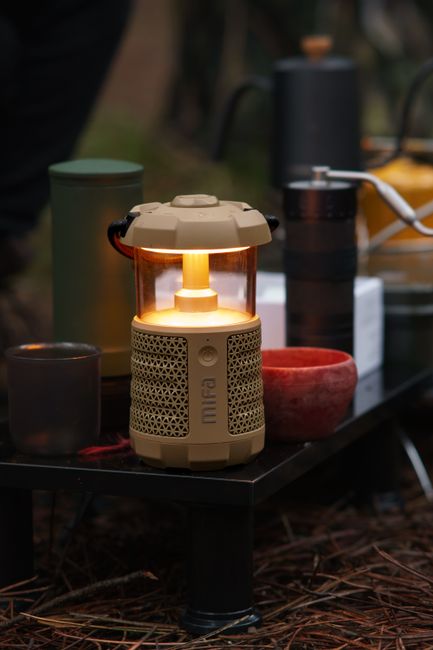
    A close-up of a glowing portable electric lantern on a camping table with cups and equipment outdoors.

    Gap 1: Inverter efficiency cuts roughly 15%

    Almost everything you plug into a portable power station runs on AC power: phone chargers, laptops, CPAP machines, fans, lights. The battery inside the station stores DC power. Every time the station converts DC to AC, it loses energy as heat.

    Good inverters lose about 10–15 percent. Budget inverters lose more.

    The math: a 500Wh station at 85% inverter efficiency delivers roughly 425Wh to your AC devices. Not 500.

    Some devices — 12V compressor coolers, USB chargers — can bypass the inverter and draw DC directly. If your power station has a 12V DC output port and your device runs on 12V, use it. DC and USB ports still have conversion losses of about 10%, but that is better than the 15% inverter cut.

    Source: inverter efficiency ratings are published in each unit’s spec sheet. The 85–90% range is consistent across mid-range units from major brands as of 2026.

    Gap 2: Depth of discharge means you cannot use every stored watt-hour

    Batteries do not like being run to zero. Doing it repeatedly kills them faster. So manufacturers program the battery management system to stop discharging before the battery is fully empty.

    How much they hold back varies:

    • LiFePO4 chemistry: typically 80–90% usable of rated capacity
    • NMC (lithium nickel-manganese-cobalt): typically 75–85% usable

    The math: a 500Wh LiFePO4 station at 90% DoD delivers 450Wh from the battery before inverter losses. Stack that with 85% inverter efficiency and you arrive at about 383Wh reaching your actual devices.

    That is about 23 percent less than the number on the box.

    Some manufacturers publish “usable capacity” separately. When they do, start with that number, not the rated capacity. Many do not.

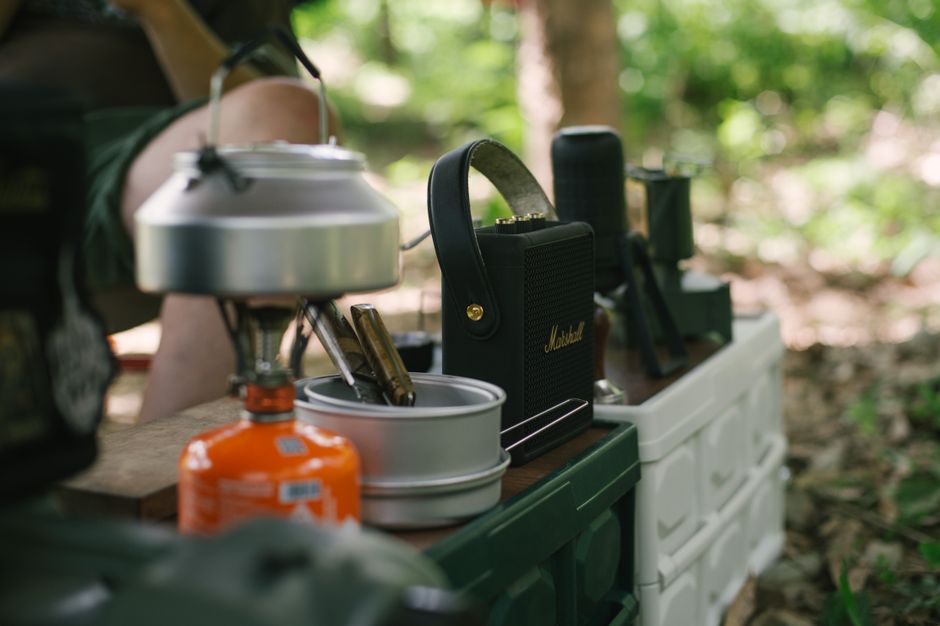
    Outdoor camping gear including a gas stove and kettle on a table in a forest setting.

    Gap 3: Devices surge at startup — and some stations cannot handle it

    Every motor-driven device draws a burst of power at startup, typically 2–3 times its running wattage. A portable fan rated at 50W continuous might pull 120W for the first half-second. A mini-fridge compressor at 60W running can surge to 150–180W.

    Power stations publish two wattage numbers: continuous output and peak (surge) output.

    If your device’s startup surge exceeds the station’s peak output, the station shuts off. It does not damage the station. It just stops.

    This catches people when they try to run a small space heater, a power tool, or an induction cooktop. Those devices often run right at the edge of what a 1,000W or 2,000W station can sustain continuously.

    The check: find your device’s starting wattage — usually labeled or in the manual. Compare it to the power station’s peak output rating, not the continuous rating.

    Gap 4: Duty cycle changes everything for compressor-driven devices

    A compressor — in a fridge, a portable air conditioner, or a 12V cooler — does not run continuously. It runs until the inside reaches target temperature, then shuts off. Then cycles again.

    This fraction of time the compressor actually runs is called the duty cycle.

    At mild ambient temperatures (65–75°F), a well-insulated portable compressor cooler might cycle at 30–40% duty. In a hot car trunk on a summer afternoon, that same cooler might run at 70–80%.

    The math matters:

    • Cooler rated at 60W continuous
    • Duty cycle in cool conditions: 35%
    • Effective average draw: 60W × 0.35 = 21W
    • Over 8 hours: 21W × 8h = 168Wh from the battery (DC direct connection)

    Same cooler, hot trunk: 60W × 0.75 = 45W → 360Wh over 8 hours.

    Same device. Same duration. More than double the draw.

    Reviewers who test compressor coolers in real conditions consistently report 30–50% higher consumption in warm ambient temperatures than the spec sheet suggests. (Source: measured data published in overlanding forums, van life communities, and independent review sites that include real-world runtime tests.)

    The corrected formula

    Here is how to actually size a portable power station:

    1. List every device. Note its wattage (continuous) and hours of use per day.
    2. Multiply: W × hours = Wh per device per day.
    3. Add them up: total Wh per day.
    4. Apply duty cycle for any compressor device (multiply by 0.30–0.75 depending on ambient temperature).
    5. Divide by inverter efficiency: ÷ 0.85 for AC devices, ÷ 0.90 for DC or USB devices.
    6. Divide by usable DoD: ÷ 0.90 for LiFePO4, ÷ 0.80 for NMC.
    7. Cold nights, partial charge cycles, and the station’s own standby draw add to real usage — they are not in the base formula. The sections below cover them separately.

    Worked example: one night of camping

    Laptop (45W, 3 hours), fan (30W, 8 hours), LED lights (10W, 4 hours), phone charging (5W, 2 hours). All connected via AC.

    Device Watts Hours Wh
    Laptop 45 3 135
    Fan 30 8 240
    LED lights 10 4 40
    Phone 5 2 10
    Total 425 Wh
    60120180240Laptop135 WhFan240 WhLED lights40 WhPhone10 Wh
    Chart: Worked example: one night of camping (Wh)

    Adjust for efficiency: 425 ÷ 0.85 (AC inverter loss) ÷ 0.90 (LFP depth of discharge) = 556Wh needed from rated capacity.

    The next standard size above 556Wh is 700Wh. A 700Wh LFP station delivers 700 × 0.90 × 0.85 = 536Wh to devices — a 26% cushion over the 425Wh needed.

    You need at least a 700Wh station for this setup. A 500Wh station will fall short overnight. That is the number the label would have you skip.

    What this means in practice

    Most first-time buyers land in the 500–1,000Wh range. Here is where each tier actually lands:

    • 500Wh: phones, laptops, and lights comfortably. A CPAP without humidifier (30–50W for 8 hours). Borderline for a 12V compressor cooler in cool conditions.
    • 700Wh: everything above, plus a CPAP with humidifier (70–120W for 8 hours). Comfortable margin for a 12V compressor cooler in mixed temperatures.
    • 1,000Wh+: induction cooktops, space heaters, power tools, or running a compressor cooler in a hot vehicle for multiple days.

    If you are searching for stations in a specific capacity range:

    The standby draw nobody accounts for

    One more thing. The power station itself draws power when it is on but idle — running its display, battery management system, and cooling. This standby draw is typically 5–15W.

    Over a 10-hour night, that is 50–150Wh consumed before any device is connected. On a 500Wh station, that can be 10–30% of your capacity gone by morning.

    Some stations let you dim the display or switch to a low-power standby mode. If yours does, use it. If it does not, the standby draw belongs in your calculation from the start.

    Measure it instead of guessing. Every number in this article is an estimate until you plug your own device into a plug-in watt meter for one evening. The standby draw above is exactly the kind of figure a spec sheet never prints and a meter shows in seconds. Plug-in watt meters on Amazon

    One rule of thumb that holds

    When all the efficiency losses stack — inverter and depth of discharge — a practical rule is that you will put about 68–80% of the labeled watt-hours into your actual devices. The lower end is NMC chemistry via AC; the upper end is LFP via DC.

    That means: multiply your actual device needs by 1.25–1.5 before shopping. A setup that needs 400Wh of real energy calls for a station rated at least 700Wh.

    It is not a perfect formula. It does not account for your specific inverter model or your specific battery chemistry. But it is closer than multiplying wattage times hours and trusting the box.

    Worth having before you size anything

    • A plug-in watt meter. The corrected formula above only works with your device’s real draw, standby included. One night of measuring replaces every assumption in this article. search Amazon

As an Amazon Associate, Off-Grid Bench earns from qualifying purchases.